Korea Exit Tax: Who Is Subject, Large Shareholder Test, and Filing Deadlines (Emigrating in 2026)
If you emigrate and become a non-resident, a large shareholder is treated as selling shares on the departure date and pays capital gains tax. The unlisted share threshold is KRW 1 billion in market value. File the day before departure and within 3 months after.
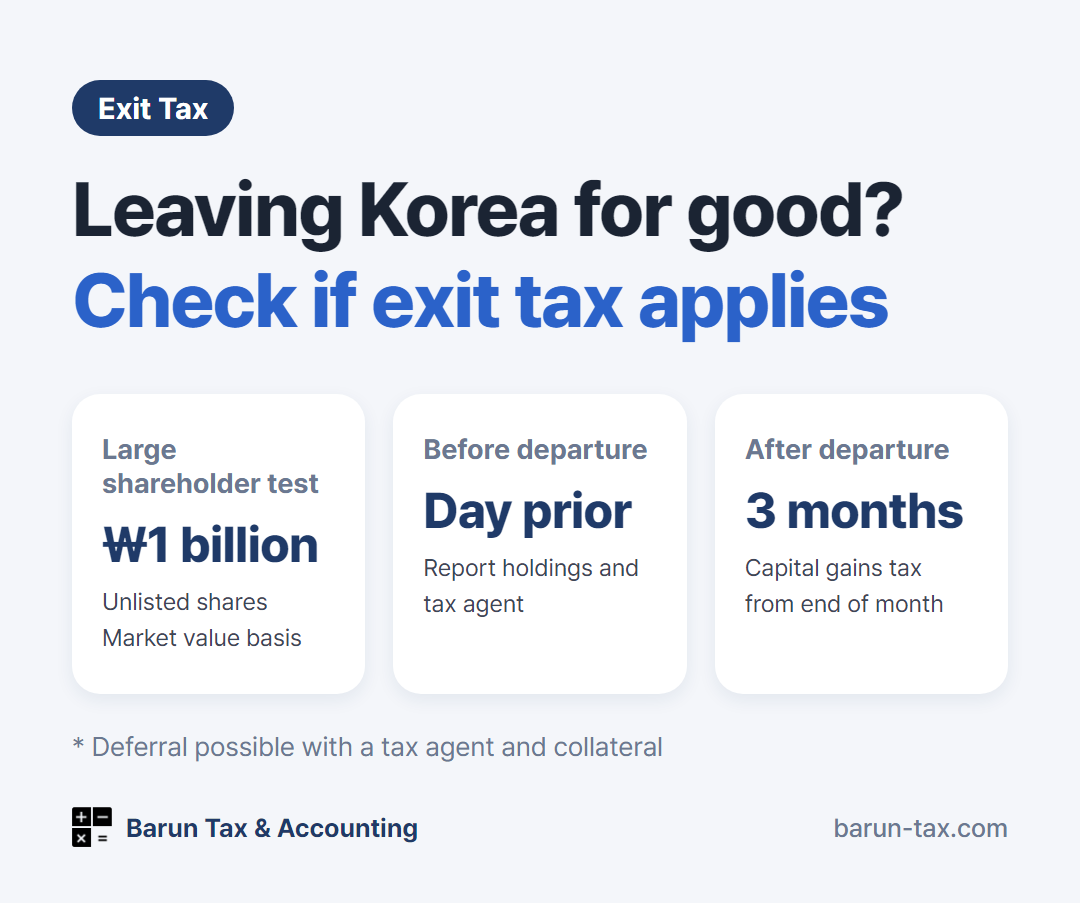
If you emigrate and become a non-resident, you pay capital gains tax as if you sold your Korean shares at their market value on the departure date. This is called the exit tax (국외전출세). You are subject to it if you lived in Korea for 5 years or more in the 10 years before departure and are a large shareholder as of the end of the prior year. You must file twice: by the day before departure and within 3 months after departure.
What the exit tax is: treated as selling shares on the departure date
When a resident emigrates and becomes a non-resident, the Korean shares held on the departure date are treated as sold at their market value on that day, and capital gains tax is charged (Income Tax Act, Article 118-9 and following).
If you sell shares after becoming a non-resident, Korea often cannot collect tax under a tax treaty. So the system settles the increase in share value earned while living in Korea before you leave.
Who is subject to the exit tax: both conditions must be met
- You had a domicile or residence in Korea for 5 years or more in the 10 years before the departure date
- You are a large shareholder as of the end of the year before the year of departure
Large shareholder test: KRW 1 billion for unlisted shares
You are a large shareholder if you exceed either the ownership ratio or the market value threshold. Shares held by related persons, such as a spouse or family, are added to your own.
| Category | Ownership ratio | Market value |
|---|---|---|
| KOSPI-listed | 1% | KRW 5 billion |
| KOSDAQ-listed | 2% | KRW 5 billion |
| KONEX-listed | 4% | KRW 5 billion |
| Unlisted | 4% | KRW 1 billion |
The market value threshold for unlisted shares is a common source of confusion. It is easy to apply the KRW 5 billion threshold for listed shares, but for unlisted shares it is KRW 1 billion (Enforcement Decree of the Income Tax Act, Article 167-8). Venture company shares traded on K-OTC have a separate threshold of KRW 4 billion.
For example, shares you received as an early startup member, or shares from exercised stock options, may be only 1~2% ownership. But if the company value rises, the valuation can exceed KRW 1 billion and you may be a large shareholder. This is why you cannot judge by ownership ratio alone.
Exit tax calculation: 20% rate, 25% on the part over KRW 300 million
| Item | Details |
|---|---|
| Transfer price | Market value on the departure date |
| Deductions | Necessary expenses such as acquisition cost, and a basic deduction of KRW 2.5 million |
| Tax rate | 20% on taxable income up to KRW 300 million, 25% on the part over KRW 300 million |
The burden is that you must pay tax even though you did not actually sell and received no money.
Exit tax deadlines: once before departure, once after
| What | By when |
|---|---|
| Report of Korean shareholdings and tax agent report | By the day before the departure date |
| Capital gains tax return and payment | Within 3 months from the end of the month that includes the departure date |
If you fail to report your holdings or omit some, a separate penalty tax applies. This overlaps with a busy time of preparing to leave, so you must prepare in advance.
Exit tax deferral: if you cannot pay right now
If you report a tax agent and provide collateral, you can defer the tax until you actually sell the shares.
- If you do not sell within 5 years from the departure date (10 years for study abroad), you must pay then.
- Interest for the deferral period is added.
If you return or sell for less: refund and double taxation relief
- If you do not sell the shares within 5 years of departure and become a Korean resident again, you can get a refund of the tax paid or cancel the deferral. You must apply within 1 year of the date the reason arises.
- If the price you later actually sell at is lower than the market value on the departure date, the tax is recalculated and you can get a refund of the difference.
- If you pay tax abroad when you actually sell, there are also rules to adjust so that you are not taxed twice.
Points that are easy to miss
- A tax treaty does not exempt you. On the departure date you are still a Korean resident, so you cannot avoid the exit tax on the basis of a tax treaty with the country you move to. It is separate from the tax on selling shares as a non-resident after you leave.
- The date for the large shareholder test is the end of the year before departure. Even if you sold some shares in the year you leave, the test is based on the end of the prior year.
- Unlisted shares are hard to value, and the tax can differ greatly depending on the valuation method. If there is a funding round price or a recent transaction price, review it as well.
- From 2027, overseas shares are also scheduled to be included in the exit tax.
If you plan to emigrate, check whether you are a large shareholder before you leave. After departure, the filing deadline has often already passed and a penalty tax applies.
When you can do it yourself · When to hand it over
You can handle it yourself if
- You clearly fall below the large shareholder threshold (for example, a small holding of listed shares)
Better to hand it over if
- You hold unlisted shares and need a market value valuation
- You must prepare the pre-departure filing and the tax deferral (collateral) together
- You sell after leaving, and double taxation relief is involved
Barun Tax & Accounting handles exit tax and capital gains tax filing for foreign residents and foreign-owned companies. We reply to emails within one business day. contact@barun-tax.com · KakaoTalk · +82-10-2701-6199