
Corporate Year-End Closing Checklist 2026: CEO Loans, Executive Bonuses, Entertainment Expense Limit
If your company has a December year-end, before December 31 sort out CEO suspense payments (가지급금), the basis for executive bonuses and severance pay, retirement pension contributions, and the entertainment expense (접대비) limit. For fiscal years starting on or after January 1, 2026, the corporate tax rate rose by 1%p in every bracket.
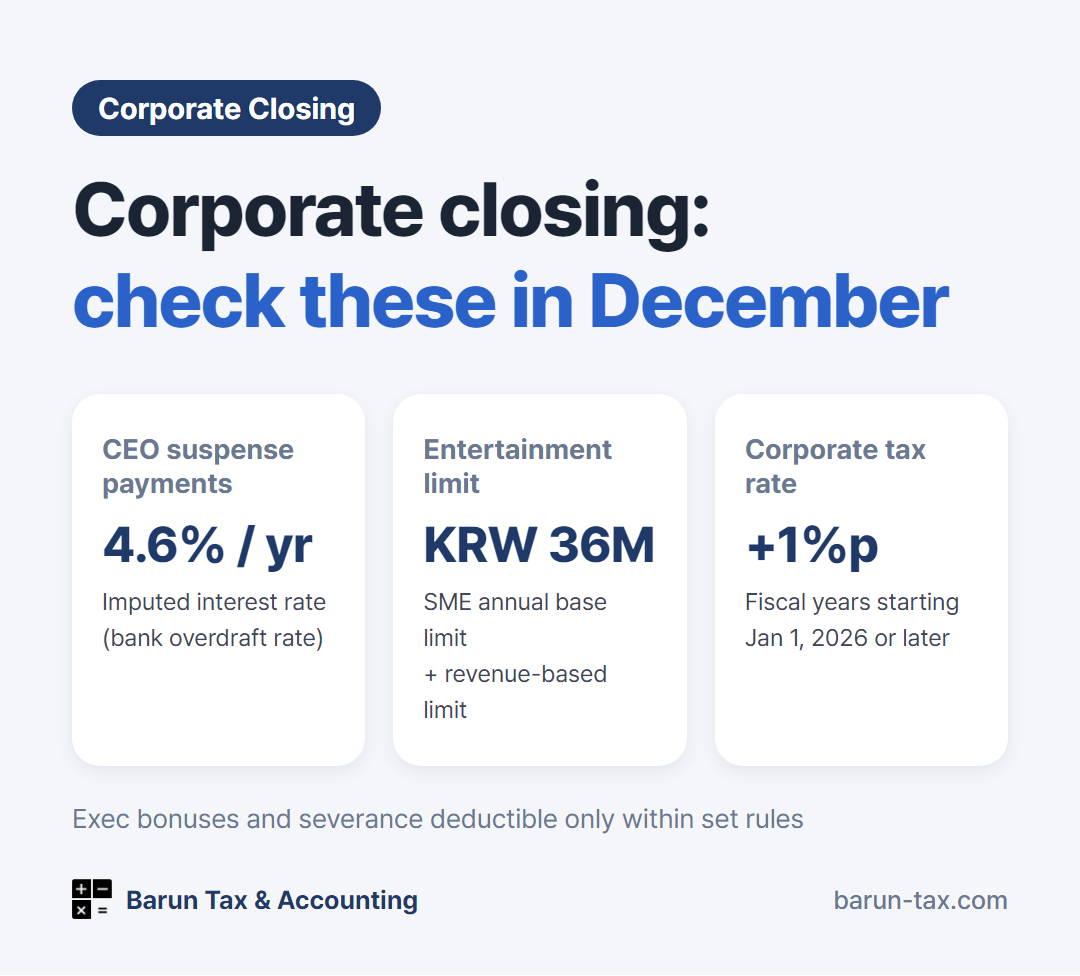
Corporate tax is calculated from your books after the fiscal year ends, but whether an expense counts as deductible is largely decided before December 31. Once the year changes, there is less you can do about suspense payments (가지급금) to the CEO, the basis for executive bonuses and severance pay, retirement pension contributions, and the entertainment expense (기업업무추진비, formerly 접대비) limit. In particular, for fiscal years starting on or after January 1, 2026, the corporate tax rate rose by 1%p in every bracket. A company with a December year-end applies the higher rate to this year’s income, which is filed in March 2027.
2026 corporate tax rates: up 1%p in every bracket
| Taxable income | Through 2025 | Fiscal years starting on or after January 1, 2026 |
|---|---|---|
| KRW 200 million or less | 9% | 10% |
| Over KRW 200 million up to KRW 20 billion | 19% | 20% |
| Over KRW 20 billion up to KRW 300 billion | 21% | 22% |
| Over KRW 300 billion | 24% | 25% |
Local income tax of 10% of the corporate tax is added separately. For small companies whose main business is real estate leasing, 20% applies to the entire range up to KRW 20 billion of taxable income. As the rate rose, the cost of amounts that are not deductible under the items below also rose.
1. CEO suspense payments: imputed interest of 4.6% per year
If money lent to a related party, such as the CEO or a shareholder, for reasons unrelated to business (suspense payments, 가지급금) stays on your books, three disadvantages follow.
- Imputed interest: Even if no interest was received, or too little, the company is treated as having received interest at its weighted average borrowing rate, and that amount is added to company income. If the company has no borrowings, or chooses to, it uses the bank overdraft rate of 4.6% per year. That amount is treated as a bonus or similar payment to the CEO, which also increases the CEO’s income tax.
- Interest expense disallowed: The part of the interest the company paid to banks that belongs to the suspense payments is not deductible.
- No bad debt write-off: Even if the money is never repaid, it cannot be written off as bad debt (a loss).
Before year-end, check the balance of suspense payments. Make a repayment plan, or put a loan agreement and interest payments in order. Repaying through salary, bonus, or dividends each results in different personal taxes for the CEO, so compare them with actual amounts.
2. Executive bonuses: deductible only within the standard set by the articles or a resolution
If you plan to pay a year-end performance bonus to executives, first check the basis for the payment.
- A bonus above the pay standard set by the articles of incorporation or a resolution of the shareholders’ meeting, members’ meeting, or board of directors is not deductible.
- A bonus paid as a distribution of profit is not deductible from the start.
- For an executive who is a controlling shareholder (including related parties), pay that is higher than other executives of the same rank without a justified reason is also not deductible for the excess part.
If there is no standard, set up a pay regulation and keep a record of the resolution before paying the bonus.
3. Executive severance pay: if the articles say nothing, total salary for 1 year × 10% × years of service
Executive severance pay is deductible only up to the amounts below.
| Case | Deductible limit |
|---|---|
| Set by the articles of incorporation (or a severance pay regulation delegated by the articles) | The amount set in the articles or regulation |
| Nothing is set | Total salary for the year before retirement × one tenth × years of service |
Severance pay is deductible only when it is paid upon actual retirement. When an employee becomes an executive, or when an interim settlement is made for a reason set by law, it is treated as actual retirement. If an executive is expected to retire next year, check the articles of incorporation first.
4. Retirement pension contributions: amounts paid by December 31
Since 2016, the deduction limit for the severance pay reserve (퇴직급여충당금) is 0%, so building it up on your books is not deductible under the Corporate Tax Act. To get a deduction in advance for employee severance pay, you must actually pay it in as a retirement pension contribution.
- Defined contribution (DC): The full contribution paid in that fiscal year is deductible. For executives, the executive severance pay limit in item 3 above applies at retirement.
- Defined benefit (DB): Deductible within a limit based on the estimated severance pay if all employees retired, among other things.
If you still have a contribution to pay this year, finish paying it before December 31 for it to count as this year’s expense.
5. Entertainment expense (기업업무추진비) limit: KRW 36 million base for SMEs
From 2024, the name of entertainment expenses (접대비) changed to 기업업무추진비. The part of your spending for the year that exceeds the limit below is not deductible.
| Category | Limit |
|---|---|
| Base limit | KRW 12 million per year (KRW 36 million for SMEs); divided by months if the fiscal year is shorter than one year |
| Revenue of KRW 10 billion or less | Revenue × 0.3% |
| Over KRW 10 billion up to KRW 50 billion | KRW 30 million + the part over KRW 10 billion × 0.2% |
| Over KRW 50 billion | KRW 110 million + the part over KRW 50 billion × 0.03% |
- For example, the limit for an SME with revenue of KRW 1 billion is KRW 36 million + KRW 3 million = KRW 39 million.
- For revenue from transactions with related parties, only 10% of the amount calculated at the rates above goes into the limit.
- Spending on culture, and spending in traditional markets or on local love gift certificates, is each recognized in addition, within 20% of the limit, through December 31, 2028.
- For companies whose main business is real estate leasing, among others, the limit is halved.
- A payment of more than KRW 30,000 at one time (KRW 200,000 for congratulatory or condolence money) must be documented with a card in the company’s name, a cash receipt, a tax invoice, or an invoice. Otherwise it is not deductible, regardless of the limit.
Add up what you spent this year now, and if you are close to the limit, adjust spending for the rest of the year.
6. Depreciation is deductible only if you record it on your books
Depreciation on assets the company bought, such as buildings, machinery, vehicles, and fixtures, is deductible only for the amount recorded as an expense on the books at closing, and within the depreciation range set by tax law. If you do not record it on your books, it is not an expense for that year. However, in a year when you receive a corporate tax reduction, you must include depreciation as an expense. A company receiving a reduction should check this before closing.
Corporate year-end closing checklist at a glance
| Item | What to do | Deadline |
|---|---|---|
| CEO suspense payments | Check the balance; put the repayment plan, agreement, and interest in order | Before December 31 |
| Executive bonus | Check the pay standard and resolution, then pay | Before payment |
| Executive severance pay | Check the articles and severance pay regulation | Before the planned retirement |
| Retirement pension | Pay this year’s contribution | December 31 |
| Entertainment expenses | Add up spending; check documentation for payments over KRW 30,000 | At year-end review |
| Depreciation | Reflect depreciation in the closing | At closing |
When you can do it yourself · When to hand it over
You can handle it yourself if
- You already have a tax agent, and you only want to use this checklist to check for anything missed.
Better to hand it over if
- Suspense payments to the CEO have built up.
- Your articles of incorporation have no standard for executive bonuses and severance pay.
- You have kept the books yourself, and this is the first time you are handing over closing and tax adjustments.
Barun Tax & Accounting handles corporate bookkeeping, year-end closing, and corporate tax filing for foreign residents and foreign-owned companies. We reply to emails within one business day. contact@barun-tax.com · KakaoTalk · +82-10-2701-6199