
January VAT for Shop and Officetel Landlords: Deemed Rent at 3.1% and Tax Invoices
Landlords of shops and business-use officetels file VAT for July–December by January 25, 2027. Rent is reported with tax invoices, and the deposit is calculated as deemed rent at 3.1% per year and reported together. You must attach the real estate rental supply value schedule (부동산임대공급가액명세서).
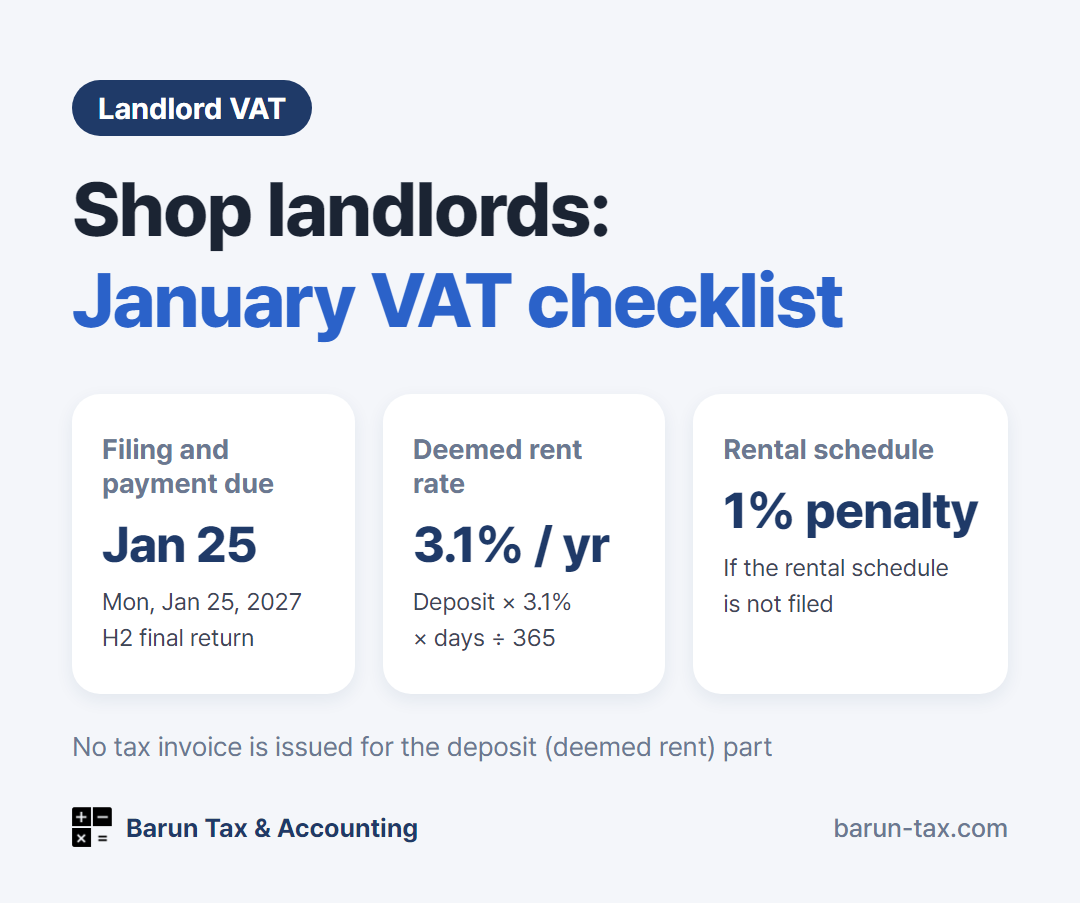
A general taxpayer who leases a shop or a business-use officetel files and pays VAT for July~December by Monday, January 25, 2027. There are two kinds of sales to report. For the monthly rent you receive, you issue tax invoices and report it. For the deposit you hold, you add deemed rent (간주임대료), calculated at an interest rate of 3.1%, to your sales. If you do not file the real estate rental supply value schedule (부동산임대공급가액명세서) with your return, a penalty applies.
The full filing calendar is in VAT filing schedule at a glance.
Landlord VAT filing deadline: January 25, 2027
| Type | Period covered | Deadline |
|---|---|---|
| General taxpayer (individual) | July 1~December 31, 2026 | January 25, 2027 (Monday) |
| Simplified taxpayer | January 1~December 31, 2026 | January 25, 2027 (Monday) |
- If an individual general taxpayer paid the preliminary notice amount in October, subtract it when paying with the January final return.
- If the unit was vacant and you had no sales in that period, you must still file (a no-sales return).
Rent tax invoices: issue on the date rent is due
The supply date of rent is the date the contract says it is due.
- Issue the tax invoice with that due date as the date of preparation. A monthly combined tax invoice that gathers one month can be issued by the 10th of the next month.
- Even if the tenant is behind and you did not actually receive the rent, you must issue and report based on the due date.
- If you receive rent covering two or more taxable periods at once, such as a year paid in advance or paid later in a lump sum, divide the amount by the number of months in the contract period and report it by taxable period.
Deemed rent calculation: deposit × 3.1% per year × days ÷ 365
A deposit is money you must return, but the VAT Act treats holding a deposit as receiving payment for the lease. So the deposit multiplied by an interest rate (deemed rent) is added to your sales.
Deemed rent = deposit × days rented in the period × 3.1% per year ÷ 365 (366 in a leap year)
- The rate has stayed at 3.1% per year since the March 2025 revision. Use the rate in effect on the last day of the taxable period.
- For example, if you held a deposit of KRW 100 million from July 1 to December 31, which is 184 days, deemed rent is KRW 100 million × 184 × 3.1% ÷ 365 = about KRW 1.56 million, and the VAT is about KRW 156,000.
- No tax invoice is issued for the deemed rent part. The landlord includes it in the return and reports and pays it directly. Who bears that VAT is decided by the contract.
- If you rent a building from someone else and sublease it, calculate on the deposit you received minus the lease deposit you paid.
Vacancy: no rent or deemed rent, input tax is still deductible
- During vacant periods there is no rent or deposit, so there are no sales for that time. Deemed rent counts only the days actually rented.
- Costs related to the rental business during vacancy, such as repair costs and brokerage fees for the next tenant, can be deducted as input tax if you keep the tax invoices.
- Even with no sales, do not skip the final return.
Real estate rental supply value schedule: 1% penalty if not filed
A landlord files the real estate rental supply value schedule (by unit: tenant, lease period, deposit, rent) with the return. If you do not file it, or fill it in differently from the facts, a 1% penalty applies to the revenue that is missing or differs. If a tenant changed or a deposit or rent changed, check the contract and update the schedule.
Simplified-tax landlords: once a year, KRW 48 million threshold
- A simplified taxpayer files the full year at once by January 25. The tax is calculated by multiplying the supply value (the amount including VAT) by the real estate rental value-added ratio of 40% and by 10%.
- If the supply value for the year is under KRW 48 million, you are exempt from paying, but you must still file.
- For real estate rental, if the supply value in the previous year was KRW 48 million or more, you cannot be taxed as a simplified taxpayer.
Officetel rental: switching to residential means paying back the refunded VAT
Housing rental is VAT-exempt. If you registered as a general taxpayer for business use and got the building VAT refunded at purchase, then rent the officetel as residential, it is treated as used for an exempt business, and you must pay the VAT back.
- Calculation = building acquisition cost × (1 − 5% × number of past taxable periods) × 10%
- A taxable period is six months, so after 20 taxable periods, that is 10 years, there is nothing left to pay back.
- Whether a tenant uses the unit for business or residence is judged by actual use, such as the contract and move-in registration, so it is best to state the purpose clearly when you sign.
Landlord January VAT checklist
| Item | What to check |
|---|---|
| Rent | Whether tax invoices were issued on the due date (including months not paid) |
| Deposit | Calculate deemed rent by unit from the deposit and days rented (3.1% per year) |
| Vacancy | Exclude vacant periods; keep tax invoices for repairs and brokerage fees |
| Schedule | Update the real estate rental supply value schedule for tenants and amounts |
| Preliminary notice | Subtract the amount paid in October from the final return |
| Officetel | Check whether any unit has been switched to residential use |
When you can do it yourself · When to hand it over
You can handle it yourself if
- You have 1~2 units, no change in tenants or deposits this year, and you have filed on Hometax before.
Better to hand it over if
- You have several units.
- A deposit or rent changed during the period.
- You switched an officetel to residential use, or there is a sublease.
Barun Tax & Accounting handles VAT and comprehensive income tax filing for landlords who are foreign residents or foreign-owned companies. We reply to emails within one business day. contact@barun-tax.com · KakaoTalk · +82-10-2701-6199