
What Is a Fair Bookkeeping Fee in Korea? Monthly Fees and Annual Total for Sole Proprietors and Companies (2026)
There is no fixed price for bookkeeping. The fee depends on sales volume, number of transactions, industry, number of employees, and scope of work. Compare quotes by annual total (monthly fee × 12 + year-end closing and filing fee). Barun Tax & Accounting starts at KRW 100,000 per month for sole proprietors and KRW 120,000 per month for companies. The adjustment fee is separate.
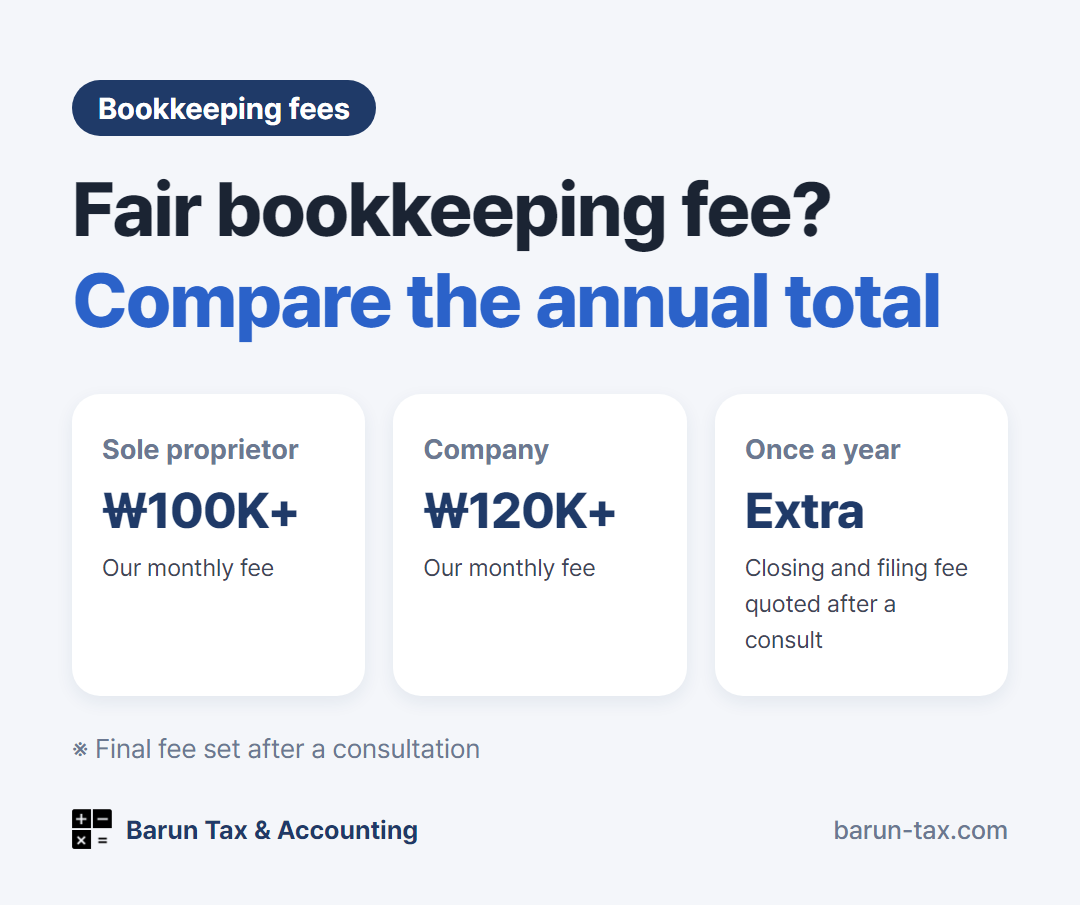
There is no fixed price for bookkeeping. The fee depends on sales volume, number of transactions, industry, number of employees, and the scope of work you hand over. The same monthly amount can cover different work. So compare quotes by the annual total (monthly fee × 12 + year-end closing and filing fee). Barun Tax & Accounting starts at KRW 100,000 per month for sole proprietors and KRW 120,000 per month for companies. The adjustment fee is separate.
Five factors that set the fee
| Factor | When the fee goes up |
|---|---|
| Sales volume | Higher sales mean more transactions and documents, so the fee rises by sales bracket |
| Monthly transactions | Many tax invoices, card payments, and cash transactions, or receipts that are not organized |
| Industry | Industries that need inventory and cost accounting, overseas transactions, or a mix of taxable and tax-exempt sales |
| Number of employees | Payroll ledger, withholding tax, four social insurance filings, and year-end tax settlement are added |
| Business type | A company is legally required to keep double-entry books, close its accounts, and make tax adjustments, so it takes more work than an individual |
What makes up the cost: monthly fee + adjustment fee + extra work
| Component | What it is | When you pay |
|---|---|---|
| Monthly bookkeeping fee | Keeping the books each month and regular filings such as VAT and withholding tax | Every month |
| Closing and filing fee (adjustment fee, 조정료) | Closing the year’s accounts and filing comprehensive income tax (individuals) or corporate tax (companies) | Once a year |
| Extra work fee | Work outside the scope (for example, filing for capital gains, inheritance, or gift tax, or a refund claim (경정청구)) | Each time |
How to calculate the annual total
Annual total = monthly fee × 12 + adjustment fee + extra work fee
If the monthly fee is low but the adjustment fee or the payroll fee is large, the annual total can end up higher. If you collect quotes from several offices, set them to the same scope of work first, then compare the annual totals.
Barun Tax & Accounting bookkeeping fees
| Type | Monthly fee | Adjustment fee |
|---|---|---|
| Sole proprietor | From KRW 100,000 per month | Separate – quoted after a consultation |
| Company | From KRW 120,000 per month | Separate – quoted after a consultation |
| Only comprehensive income tax or capital gains tax filing | – | Quoted after a consultation |
- Included in the monthly fee: monthly bookkeeping, VAT and withholding tax filing, four social insurance filings, year-end tax settlement — if you have employees, the fee may vary with the number of employees
- Separate: the once-a-year closing and filing fee (adjustment fee) for comprehensive income tax (individuals) or corporate tax (companies), and the confirmation fee for sole proprietors subject to the faithful filing confirmation (성실신고확인)
The bookkeeping fee is confirmed after a consultation, based on transaction volume and scope of work. Amounts by industry, sales, and number of employees are in Bookkeeping fee examples by situation.
The fee is an expense, and there is a bookkeeping tax credit
- Bookkeeping and adjustment fees are business costs, so they are treated as expenses.
- If a simplified-bookkeeping filer files with double-entry books, you get the bookkeeping tax credit (기장세액공제). It is 20% of the calculated tax on business income from the books, up to KRW 1 million.
- If you file without books, a no-bookkeeping penalty tax (무기장가산세, 20% of the calculated tax on income without books) may apply instead. Businesses in their first year and businesses with prior-year revenue under KRW 48 million are excluded.
When you can do it yourself · When to hand it over
You can handle it yourself if
- You are a simplified-bookkeeping filer, your sales and expenses are all in Hometax, and you only need to file yourself
Better to hand it over if
- You are required to keep double-entry books, or you run a company
- You have employees, so payroll and four social insurance filings come up every month
- You have many transactions and bookkeeping takes a lot of time
Barun Tax & Accounting handles bookkeeping for foreign residents and foreign-owned companies, starting at KRW 100,000 per month for sole proprietors and KRW 120,000 per month for companies. We reply to emails within one business day. contact@barun-tax.com · KakaoTalk · +82-10-2701-6199