
Just started a business in Korea: do you need to hire for bookkeeping? Simple vs. double-entry rules
A sole proprietor is a simple bookkeeping filer in the first year of business and in any year when prior-year revenue is below the industry threshold (KRW 300 million for wholesale and retail, KRW 150 million for restaurants, KRW 75 million for services). At or above the threshold, double-entry books are required, and filing without books adds a no-bookkeeping penalty. A corporation uses double-entry books from the start.
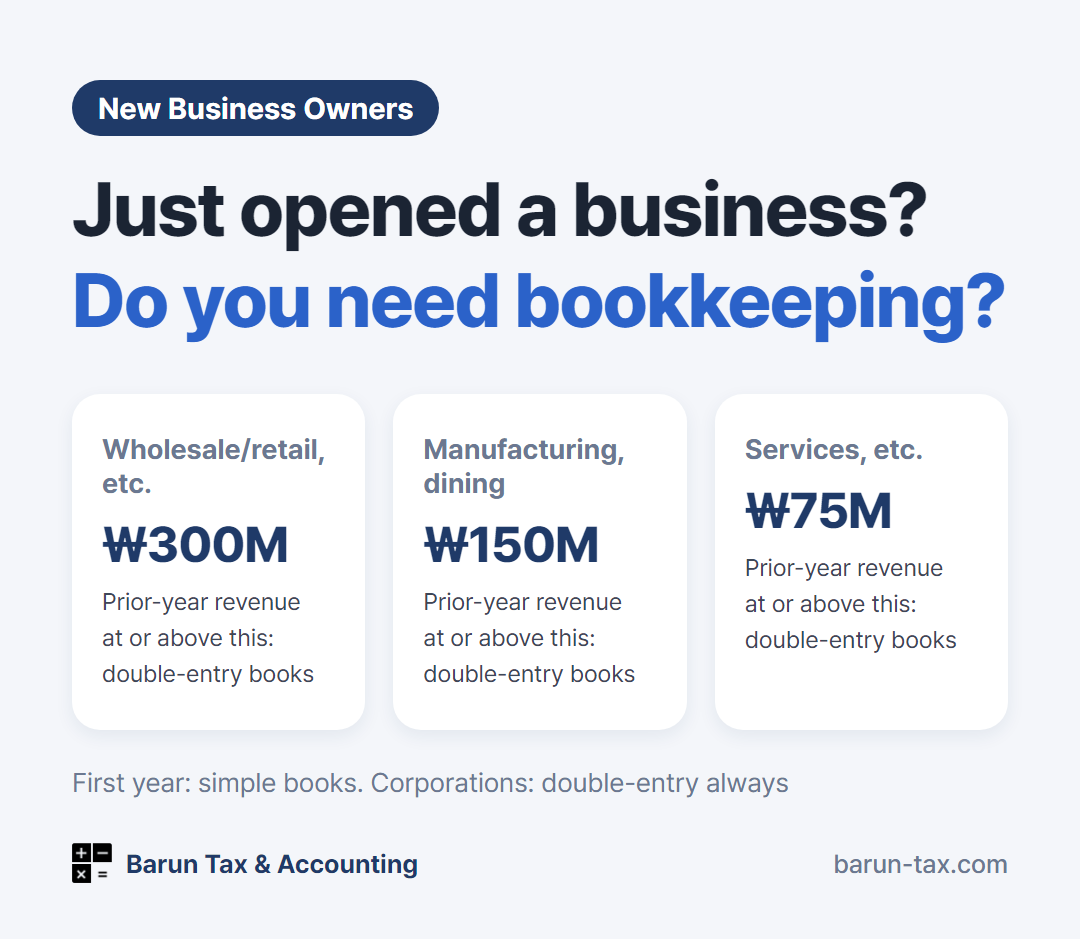
A sole proprietor is a simple bookkeeping filer in the first year of business and in any year when prior-year revenue is below the industry threshold (KRW 300 million for wholesale and retail, KRW 150 million for restaurants, KRW 75 million for services), and may keep simple books. At or above the threshold, double-entry books are required, and filing without books adds a no-bookkeeping penalty (무기장가산세) of 20% of the calculated tax. A corporation uses double-entry books from the start.
Simple vs. double-entry thresholds (prior-year revenue)
| Industry | Double-entry filer at or above this amount |
|---|---|
| Agriculture, forestry, fishing, mining, wholesale and retail, real estate sales and similar | KRW 300 million |
| Manufacturing, lodging and restaurants, construction, transportation, information and communications, finance and insurance and similar | KRW 150 million |
| Real estate rental, professional, scientific and technical services, business support services, education services, health care, arts, sports and leisure, repair and other personal services and similar | KRW 75 million |
- In the first year of business, you are a simple bookkeeping filer regardless of revenue. If revenue that year exceeds the threshold, you become a double-entry filer from the next year.
- If you run more than one industry or more than one business location, the amounts are converted to the main industry’s basis and added together.
- Professionals such as doctors, lawyers and tax accountants are double-entry filers regardless of revenue.
If you do not keep books: 20% no-bookkeeping penalty
If you do not keep books, or the income in your books is lower than the actual income, you pay an additional 20% of the comprehensive income tax calculated on that income as a no-bookkeeping penalty (무기장가산세).
| Category | No-bookkeeping penalty |
|---|---|
| First year of business | None |
| Prior-year revenue below KRW 48 million | None |
| All other businesses | Calculated tax on income without books × 20% |
Without books, you file using estimated income (추계신고): income is calculated with government-set expense rates instead of your actual expenses. In industries with high expenses, this tends to raise your tax.
If a simple bookkeeping filer uses double-entry books: bookkeeping tax credit of up to KRW 1 million
A simple bookkeeping filer who keeps double-entry books and files with them receives the bookkeeping tax credit (기장세액공제). It is 20% of the tax calculated on business income computed with double-entry books, capped at KRW 1 million. Filing with books lets you deduct your actual expenses, and if you have a loss, you can carry it forward and deduct it in later years.
When you can do it yourself, and when to hire
| Situation | Judgment |
|---|---|
| Simple bookkeeping filer, no employees, sales and expenses appear in Hometax through cards and tax invoices | You can keep simple books and file yourself using Hometax data |
| Corporation | Double-entry books from the start, with year-end closing and tax adjustment, so most hire a firm |
| You became a double-entry filer, or are likely to next year | Books are required, so hiring is safer |
| You plan to hire employees | Payroll, withholding tax and four major social insurance filings arise every month |
| Large purchases at opening, such as interior work or equipment | Expenses, depreciation and VAT refunds need attention |
If you hire from the start, you will not miss receipts for early spending, and you will not need to build books from scratch in the year your revenue crosses the threshold.
When you can do it yourself · When to hand it over
You can handle it yourself if
- You are a simple bookkeeping filer, and your sales and expenses all appear in Hometax through cards and tax invoices
- You have no employees and only a few customers
Better to hand it over if
- You started as a corporation (double-entry books from the start)
- You have become a double-entry filer, or are likely to next year
- You are hiring employees, so payroll, withholding tax and four major social insurance filings will start
- You made large purchases such as interior work or equipment, so expenses, depreciation and VAT refunds need attention
Barun Tax & Accounting handles bookkeeping and filings for foreign residents and foreign-owned companies that have just started a business. We reply to emails within one business day. contact@barun-tax.com · KakaoTalk · +82-10-2701-6199