
How to switch tax accountants in Korea: steps and what to prepare when moving your bookkeeping
You can change your tax accountant (bookkeeping agent) at any time, and the tax office does not penalize you for it. The steps are: sign with the new firm, approve it in Hometax, then collect the prior books and filings. The best time to switch is right after you finish a filing.
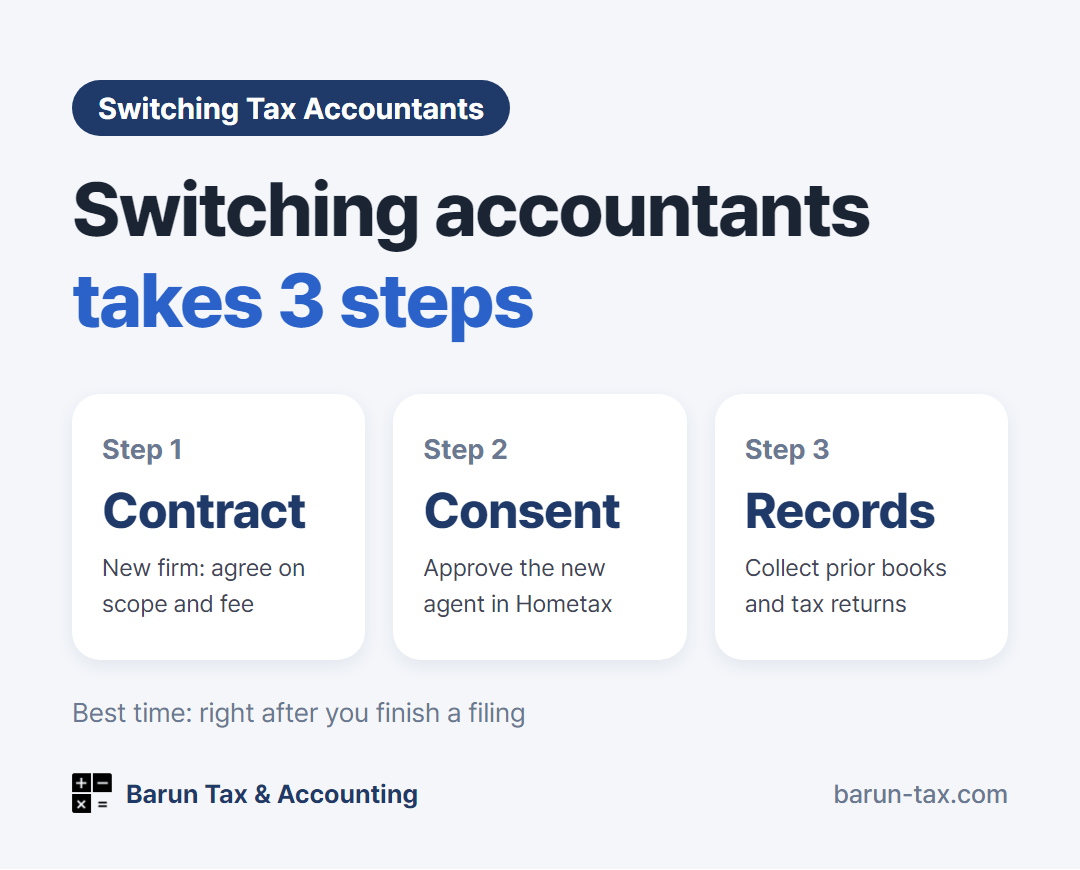
You can change your tax accountant (bookkeeping agent) at any time. The tax office does not view a change unfavorably. There are 3 steps: sign with the new firm, approve the new agent in Hometax (홈택스), then collect the prior books and filings. The best time to switch is right after you finish a filing.
Why people switch tax accountants
- They are hard to reach, or answer questions slowly
- They ask for all your documents at once right before a filing, and do not tell you the expected tax in advance
- The staff member in charge changes often, so you explain everything from scratch each time
- Your business has grown and now needs something the current firm cannot handle, such as incorporation, employee payroll or overseas transactions
If these problems keep happening, switching is the better choice. The business owner chooses the tax agent, so you do not need the previous firm’s consent.
The 3 steps to switch tax accountants
| Step | What to do | Who |
|---|---|---|
| 1. Contract | Tell the new firm your business type, revenue, number of employees and the services you need, then agree on the scope of work and the fee and sign | Business owner and new firm |
| 2. Approval | The new firm registers as your agent in Hometax, then you approve it | New firm registers, business owner approves |
| 3. Records transfer | Collect the books and filing records from the previous firm | Often requested by the new firm |
Tell the previous firm that you are switching and which filing period is the last one they will handle. First check your contract for a termination notice period or a remaining commitment term.
Records to collect from the previous tax accountant
The new firm needs past records to continue your books.
- Past returns: value-added tax (VAT), comprehensive income tax or corporate tax, and withholding tax
- Books such as financial statements and account ledgers
- Fixed asset and depreciation schedule
- Details of net operating loss carryforwards
- Payroll register and four major social insurance records (if you have employees)
With these records, balances such as bank accounts, receivables and loans match the previous books, and loss deductions and depreciation continue without a gap.
Best timing: right after you finish a filing
| Business type | Best time to switch | Why |
|---|---|---|
| Individual general taxpayer | Right after the VAT final return in January or July, or right after the comprehensive income tax filing in May | The previous firm has finished filings for that period, so the new firm continues from the next period |
| Corporation (December year-end) | Right after the corporate tax filing in March | Closing the books and tax adjustment are done, so there is nothing to split |
If you switch just before a filing deadline, the deadline gets tight while the records are being handed over. If a deadline is already close, first agree with both firms on who will handle that filing.
What to check before switching
- Scope of work: Whether VAT, withholding tax, four major social insurance and year-end tax settlement are included in the bookkeeping fee, and whether the year-end closing and filing fee (adjustment fee, 조정료) is charged separately
- Fee: The monthly bookkeeping fee and the total for one year (monthly bookkeeping fee × 12 + adjustment fee)
- How to contact them: Who you contact, through which channel, and how quickly they reply
When you can do it yourself · When to hand it over
You can handle it yourself if
- Your transactions are simple, you plan to keep the books yourself, and you only need to keep your prior returns
Better to hand it over if
- You can hardly reach your current accountant, or they ask for your documents only right before a filing
- A filing deadline is close and you need the prior records quickly
- You suspect deductions or expenses were missed in past filings
Barun Tax & Accounting handles bookkeeping takeovers for foreign residents and foreign-owned companies, including collecting books and filings from the previous accountant. We reply to emails within one business day. contact@barun-tax.com · KakaoTalk · +82-10-2701-6199